How to Restore & Protect Mature White Oak Trees in East Texas
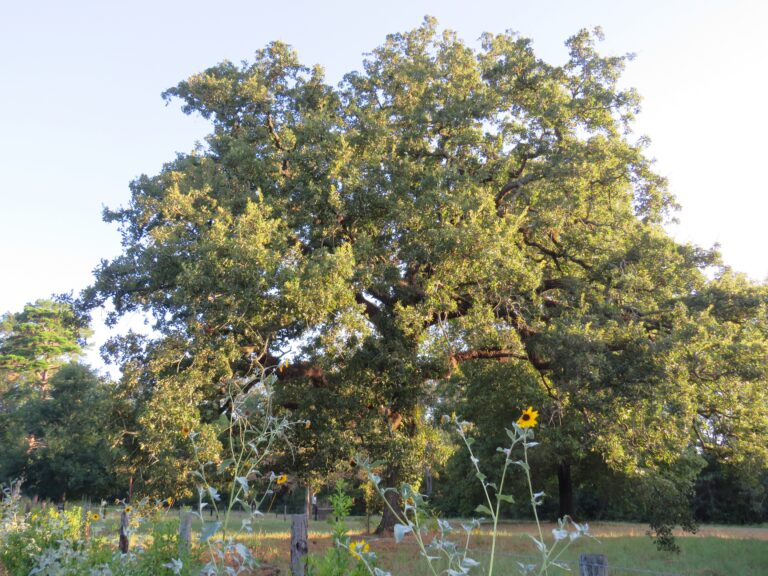
When searching for land in East Texas, our realtor took my husband and me to Northeast Smith County and presented a property to us located along Harris Creek containing a forest within an iron ore-based soil. The forest is a mix of mature evergreen, a deciduous canopy and lots of understory trees and shrubs with a steep elevation, large iron ore rock, and lots of fern. At the base of the property’s drive was a giant white oak tree – the largest I’ve ever seen. We immediately fell in love with the land and became the owners.
Land Stewardship & Professional Observation
I believe it is important to be a good steward of land. Upon purchase of the property, my primary goal was to have the forest’s health evaluated so we hired a local arborist-botanist to observe our newly purchased land.
Our property has many large white oaks that are 200-300 years old. During the observation, we found that our very large white oak at the base of our driveway, is roughly 400 years old. She is a beautiful specimen measuring nearly 13 feet in diameter at chest height.
Identifying the Problem: Compaction & Borers
Due to the driveway location, her roots were being driven across, causing compaction of the soil in the root zone. The compaction was causing the tree to be in a state of stress, weakening her immune system and making her become very susceptible to borers that were attaching and showing damage.
For an interesting article about Oaks from Doug Tallamy, click HERE.
The Arborist’s Recommended Plan
The arborist recommended a treatment and a local company to apply the treatment. He also recommended:
- Relocating the driveway 40 feet away outside of the specimen’s root zone area.
- Applying 4 inches of mulch over the root zone where the current driveway was located.
- Removing most of the surrounding sapling trees within her root zone to remove competition for nutrients.
Implementing Restoration Measures
It was never a question as to if we would or would not follow the arborists’ recommendations to restore the tree’s health. This tree was a mere sapling when the Delaware Indian’s roamed our property and now serves as a host to so many species of wildlife. I could not bear, after 400 years, to be the person leading to her demise.
Without a second thought, we followed the arborist’s recommendations:
- Driveway Relocation: We immediately stopped using the driveway and relocated it just over 45 feet outside of the root zone.
- Targeted Treatment: We called the company our arborist recommended and had the tree treated with the prescription ordered.
- Mulching: We utilized organic matter from our own property to create a nice new bed of mulch where the old driveway was located.
Two-Year Results & Long-Term Outlook
It has been two years since the changes were implemented for the tree. We requested our arborist come back to follow up on how our “great white oak” is doing.
We are happy to know that she no longer shows any sign of stress, no longer has a borer problem, and is seemingly a very happy 400-year-old tree (that is beloved by our family, who calls her our “Great White Oak”). With the ecological gardening measures we implemented, hopefully she’ll live on for another 100 years!

Stacy Gates
Smith County Master Gardeners are volunteer educators certified and coordinated by the Texas A&M AgriLife Extension Service