
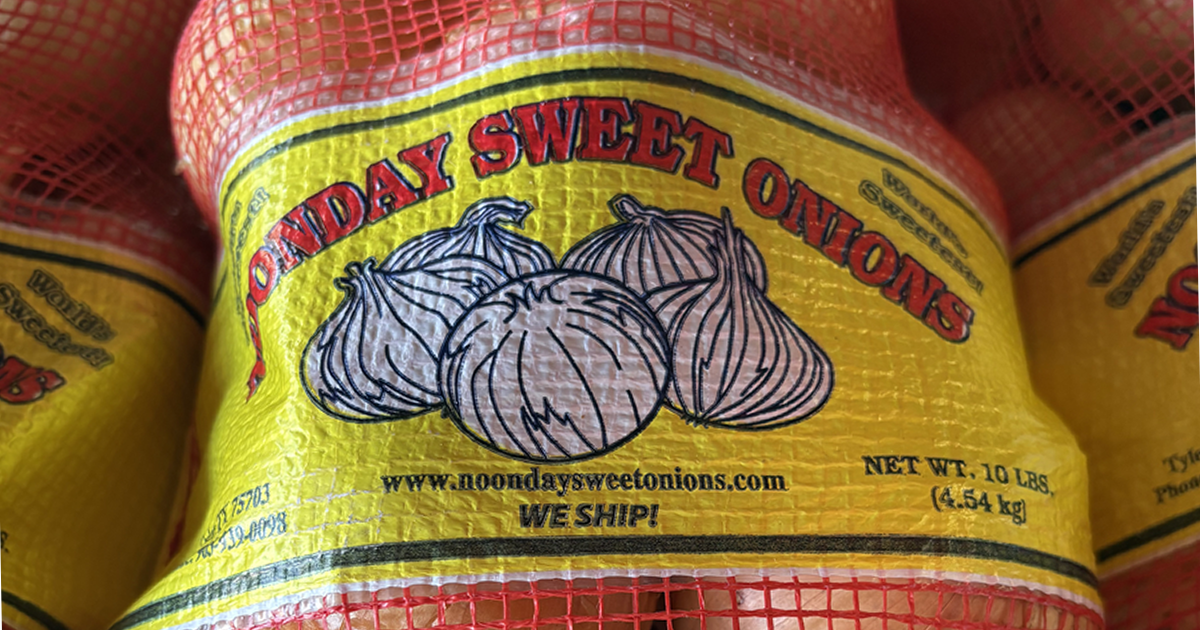
What Makes Noonday Sweet Onions Texas’s Favorite Crop?
Discover the secret behind Noonday Sweet Onions! Learn their rich history, unique Spanish origins, and where to buy these iconic Texas sweet onions.
The Legacy of the Noonday Sweet Onion
The Noonday Sweet Onion has built a legacy for being perfectly sweet, mild and crunchy. As someone who, for the first few decades of life, was quick to decline onions whenever offered, believe me when I tell you: You haven’t tried an onion till you’ve tried a sweet one. Specifically, a Noonday Sweet Onion. Think battered and deep-fried rings, thick slices on a burger, or grilled with peppers on a fajita!
The Noonday onion came into being in the early 1980s when several local farmers began experimenting with growing yellow onions. They soon discovered they could produce exceptional sweet yellow onions. Word quickly spread and soon there were dozens of local growers producing Noonday Sweet Onions. Although the number of growers has declined significantly over the past four decades, there are still farmers who grow these sweet onions and make them available for those of us who eagerly await each year’s crop.
Where to Buy Certified Noonday Onions
It’s well worth the drive to stock up at farm stands near Noonday on State Highway 155, a few miles southwest of Tyler. You can also often find them at local farmers markets, including the Tyler Farmers Market at Broadway Square Mall. Select regional grocery stores, including more than two dozen Brookshire’s Food Stores and a half-dozen DFW-area Central Markets, offer Noonday onions. Shipping is available from mid-May through June by ordering online.
Unique Origins and Ideal Growing Conditions
The Noonday onion, along with Georgia’s Vidalia onion, originate from the Grano 502, which is considered the mother of all super sweet onions. Each of these varieties thrive in their respective areas’ fertile, sandy loam and low-sulfur soils. Only onions grown within a 10-mile radius of Noonday can be considered a true, certified Noonday Sweet Onion.
The History and Breeding of the Grano 502
The Grano was originally imported from Valencia, Spain, in 1925. Its Texas roots stretch back to a 1930s onion-breeding program where horticulturists at the Texas Agricultural Experiment Station in south Texas began trialing the early-producing, high-yielding onion. The program was expanded in 1939 through a partnership with the U.S. Department of Agriculture, which resulted in the introduction of the short-day Texas Early Grano 502 in 1944 by what is now Texas A&M.

Ellen Reynolds
Smith County Master Gardeners are volunteer educators certified and coordinated by the Texas A&M AgriLife Extension Service.