Why Less Water is Better for Your Lawn
I thought growing a lawn was easy. When we moved to Tyler eight years ago, I dreamed of gorgeous expanses of green grass on our two acres. Turns out most of our property was bare dirt in heavy shade, and what turf we did have in the sun was a variety I had never heard of. I am still working on establishing turf and I have made many mistakes, but the biggest one is incorrectly watering.
Although watering is one of the most basic practices in lawn maintenance, it is also the one most often done incorrectly. The Texas AgriLife Extension office recommends that lawns get one inch of water per week, either via natural rainfall or via a sprinkler system. In East Texas, Mother Nature typically provides adequate rainfall for most months, but we often need to supplement in June, July, and August.
How Long Should You Run Your Sprinklers?
When watering, it is important to know how long to run your sprinklers to achieve one inch. This can vary based on your type of sprinkler system and the water pressure to your home. I have a friend who gets one inch in 20 minutes on city water, but it takes over 90 minutes at my home.
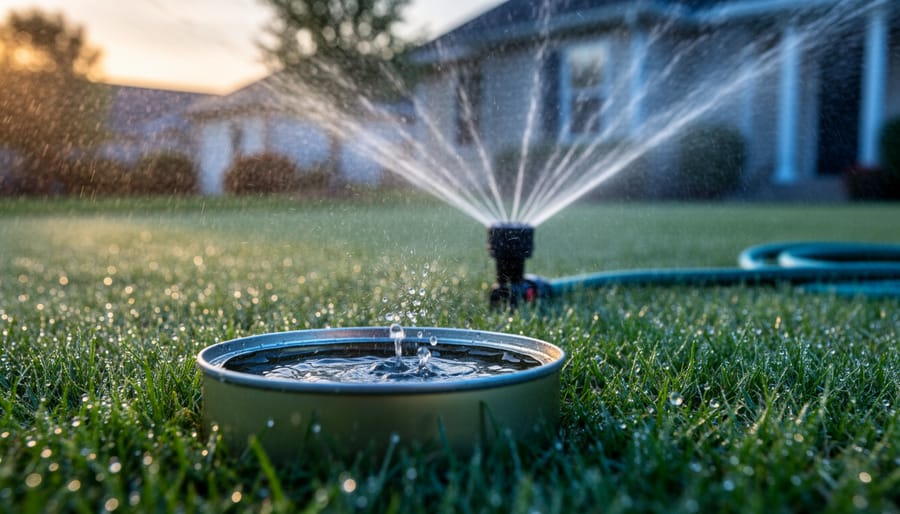
How to Perform a Lawn Catch Can Test
To determine the exact length of time to water, perform a simple “catch can” test:
- Set Up Containers: Place small containers (tuna or cat food cans work great) on your lawn in a grid pattern in each sprinkler zone. Ensure containers are uniform and at least 1 inch deep.
- Run Sprinklers: Run your sprinkler zone for 15 minutes.
- Measure Depth: Use a ruler to measure the water depth in each container and note the results.
- Calculate Hourly Rate: Multiply your 15-minute measurement by 4 to get your hourly rate.
- Repeat by Zone: Repeat the test for each zone, as automated sprinkler zones can differ significantly.
Why Deep Watering Beats Daily Sprinkling
Now that you know how long to water to achieve one inch, the goal is to water deeply and less frequently. That means watering longer only once per week—not every other day for a few minutes.
- The Problem with Frequent Shallow Watering: Encourages shallow root systems that burn out easily during hot weather.
- The Benefit of Deep Watering: Letting the lawn dry out between waterings forces grass to develop deeper, more extensive, and more resilient roots that absorb moisture efficiently.
If you practice deep watering early in the season, you’ll successfully prepare your lawn to handle the intense heat of August.
Preventing Runoff and Water Waste
Pay attention to any areas of your lawn experiencing runoff or ponding. If your soil can’t absorb water as quickly as your system applies it, try the “Cycle and Soak” technique:
- Divide long run times into two or more shorter cycles on the same day.
- Allow time between cycles for water to penetrate into the soil before adding more.
- Multiple shorter cycles during a single watering day are far better than increasing the total number of watering days per week.
If you would like a video of how to set up catch cans in your yard, click HERE.

June Reese
Smith County Master Gardeners are volunteer educators certified and coordinated by the Texas A&M AgriLife Extension Service.